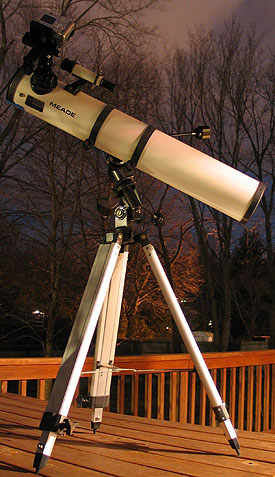
Although I'm just getting started in this field, here's a few tips & tricks I picked up:
Focus
If your camera has the feature, place it in continual focusing mode. Then adjust the telescope's focus until you get a crisp image in the LCD display.
Camera Shake
The greater power the lens the more camera shake will blur your photos. Most telescopes are mounted to good solid tripods but even these can wobble some when you press the shutter release. To avoid this use your camera's timer mode to delay the taking of the photo. This will give the telescope time to stop wobbling before it takes an exposure.
Exposure Time
This is where things can get challenging. As you know the Earth is spinning in space. With large magnification objects in the heavens tend to track across the frame at quite a clip. You need to limit your exposure time to avoid ending up with a streak across your photo as the object tracks across the sky. At the same time you also want enough time to gather what little light might be coming from your subject. Finding the balance is part of the fun though.
Tracking Objects
One solution to the problem of Earth's motion in relation to your subject during long exposure times is to have the telescope track the object as it moves. With some practice you should be able to gently turn the telescope's fine tuning wheels to follow the object. Better still is to use a tracking motor/control system.
Magnification
So far I've limited my astrophotography to fairly low power settings using my 25mm eye piece. This provides a nice wide field of view & makes aligning the camera less critical. I have found that using the camera's zoom is quite effective at increasing magnification. There's room for all manner of experimentation here though. You might try adding a doubling 2 x barlow attachment or higher powered eye pieces. |