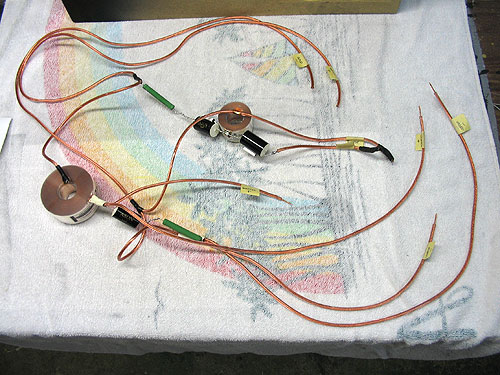


Audiophile level speakers almost always employ some electronics. A "crossover network" is a circuit that splits the audio signal into various frequencies then routes that to specific speaker drivers. The high frequencies go to the tweeter. The midrange & bass to the woofers. Choosing the correct components for a crossover network involves some complicated math & a good understanding of both electronics & acoustics.
I did a lot of research into crossover design, played around with several software programs & now have a fairly good understanding of how it all works. This being my first high end speaker building project I felt it was best to leave this part of the design to the experts. So I ordered two assembled crossover networks from GR Research. These were tailored to their A/V-3 MTM speaker which uses the same tweeter & woofers I'm using here. The A/V-3 has virtually the same driver layout as the Proteus, with only slightly different spacing & position. Although the crossover network was calibrated precisely for the A/V-3 I figured they would be close enough for my purposes. I could always tweak it later if needed.
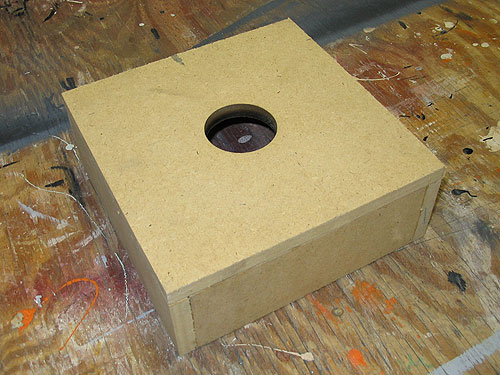
To allow future ease of tweaking to the electronics I decided to mount the circuit in an external box. This would let me gain access to the components without having to remove the drivers. It also simplified the hookup, not having to secure all that spaghetti & make it rattle proof in side the enclosure. The electronics box would be mounted on the rear of the speaker.
|